
I've had the opportunity to compare my Caliper Sigs to Vivid B-1s, K-1s, Giya G3s, Giya G2s and Wilson Sasha W/Ps, and in each case either the dynamic speaker was bright or the Apogees slightly rolled off.
Has anyone else here noticed this?
Apogees rolled off or other speakers bright?
Moderator: Graz
21 posts
• Page 1 of 1
Apogees rolled off or other speakers bright?
 by kucharsk on Wed Feb 27, 2013 1:02 pm
- kucharsk
- Posts: 38
- Joined: Mon Mar 07, 2011 7:54 pm
- Location: Colorado
Re: Apogees rolled off or other speakers bright?
by Ralph on Thu Feb 28, 2013 5:12 am
The treble ribbon in the Calipers is arguably not the best treble/tweeter in the apogee range. (probably rates amongst the worst actually)
Were the other speakers hooked up to the same amp as yours ?
Ralph
Were the other speakers hooked up to the same amp as yours ?
Ralph
I don't drink too much coffee - you're listening too slowly.
-

Ralph - Posts: 92
- Joined: Thu Jul 01, 2010 11:46 pm
- Location: Northern NSW Australia
Re: Apogees rolled off or other speakers bright?
by kucharsk on Thu Feb 28, 2013 6:55 am
Same amp, but both pairs were not connected at the same time. 
- kucharsk
- Posts: 38
- Joined: Mon Mar 07, 2011 7:54 pm
- Location: Colorado
Re: Apogees rolled off or other speakers bright?
by apogee_admin on Thu Feb 28, 2013 6:31 pm
Are we comparing standard Calipers here or restored ones?
Standard can really suck in the high frequencies, rebuilt with KLM5 ribbons, upgraded ribbon return kit and quality crossover parts and they would be equal on extension and from what I have heard (Vivid and Wilson) better subjectively.
Jon
Standard can really suck in the high frequencies, rebuilt with KLM5 ribbons, upgraded ribbon return kit and quality crossover parts and they would be equal on extension and from what I have heard (Vivid and Wilson) better subjectively.
Jon
-

apogee_admin - Site Admin
- Posts: 190
- Joined: Thu Jul 01, 2010 3:27 pm
- Location: Birmingham, UK
Re: Apogees rolled off or other speakers bright?
by artm on Thu Feb 28, 2013 8:57 pm
1. maybe the synergy between your gear and the Apogees is not as good as with the other speakers? Does the response improve by electronically boosting that range?
2. maybe the Apogee ribbon is "loose"? Surely that impairs high frequency response. If so, and you want to tinker, why not try to pull the ribbon a bit and make it more taught? I don't know if you can do this by slacking the clamp and retightening it but I would ask the one person who does know.
If you are dissatisfied with the existing sound and you plan on replacing the ribbons any time soon I would try #2 first
- artm
- Posts: 119
- Joined: Thu Jul 01, 2010 10:41 pm
- Location: Boston, MA USA
Re: Apogees rolled off or other speakers bright?
by kucharsk on Fri Mar 01, 2013 5:07 am
Caliper Signatures freshly restored in 2009.
As I said, I can't say whether the Apogees are rolled off or the Vivid Giya G2s I've been listening to are bright, but I've never read a review of the latter saying they were bright.
As I said, I can't say whether the Apogees are rolled off or the Vivid Giya G2s I've been listening to are bright, but I've never read a review of the latter saying they were bright.
- kucharsk
- Posts: 38
- Joined: Mon Mar 07, 2011 7:54 pm
- Location: Colorado
Re: Apogees rolled off or other speakers bright?
by artm on Fri Mar 01, 2013 5:33 am
What about the switch in the back? I have mine set to normal with an H2O Signature S250 with no problems.
I would setup a mic and some software to see what the response is. Feed it with an impulse and see what it does.
I would setup a mic and some software to see what the response is. Feed it with an impulse and see what it does.
- artm
- Posts: 119
- Joined: Thu Jul 01, 2010 10:41 pm
- Location: Boston, MA USA
Re: Apogees rolled off or other speakers bright?
by kucharsk on Fri Mar 01, 2013 9:44 am
I've got the switch set to "High" just for the sake of comparison and the Caliper Sig still sounds dull compared to the Vivids, which seems to be a common reaction (some reviews have stated that they're not bright but will make every other speaker sound rolled off by comparison.) 
- kucharsk
- Posts: 38
- Joined: Mon Mar 07, 2011 7:54 pm
- Location: Colorado
Re: Apogees rolled off or other speakers bright?
by apogee_admin on Fri Mar 01, 2013 12:33 pm
Don't take this the wrong way, but with the Caliper switch in circuit you are comparing the sound of the switch more than anything else.
On the Caliper it will lose air and smother the top end dynamics, there is extension there but it's "sat on".
Also the standard crossover configuration and parts are not ideal.
Having said that I do think the Vivids sound bright when I have heard them, I think too many speaker manufacturers aim for a flat frequency response to 20kHz which ends up sounding overly bright when you play louder than whatever level they tested at, due to the way our hearing works.
-
apogee_admin - Site Admin
- Posts: 190
- Joined: Thu Jul 01, 2010 3:27 pm
- Location: Birmingham, UK
Re: Apogees rolled off or other speakers bright?
by Scinemaniac on Fri Mar 01, 2013 11:20 pm
Apogees are 'line source' (panel speakers).
In near-field, sound from different parts of the ribbon arrives at the ear at different times (or phase)...
sound from the mid-part of the treble ribbon will arrive first, then sound from the upper & lower parts of the ribbon arrive progressively later. Some of this will cancel, if the listener is close to the speaker. So the closer one sits to the speakers, the less top end.
A good thing about 'line source' speakers is they beam the sound, and are relatively unaffected by bounce off the ceiling or floor, respective to 'point' source loundspeakers (ie. cone speakers).
Listening to Apogees at a distance, like in a larger room is breathtaking. The sound does not dissipate in the same way as does the sound from 'point' souce speakers, and the image snaps into place.
- Scinemaniac
- Posts: 69
- Joined: Tue Jul 06, 2010 1:22 pm
Re: Apogees rolled off or other speakers bright?
by kucharsk on Sat Mar 02, 2013 6:36 am
I do know that - I've had my Caliper Signatures since 1990 (and normally keep the switch in "Norm.")
I'm just trying to figure out what to upgrade to - I would like more bass and not have to deal with my Caliper Sigs' resonance issue on certain instruments and female vocals anymore.
Thus the two contenders are the Vivid Audio Giya G2s and a pair of Rich Murry's Duetta Signature Ultimates (I'd go Diva, but my room isn't quite large enough.)
As anyone who's listened to the Vivids knows, they're simply incredible dynamic speakers, never sounding like cones and like all dynamics wickedly fast and able to generate bass Apogees can only dream of, shaking the room on the heartbeats at the start of "Dark Side of the Moon" where every Apogee, including the Diva, can seemingly only generate kind of a "fwuff fwuff."
However, there are those certain points in time where you can occasionally tell the Vivid tweeter is only about 2" in diameter rather than a ribbon extending for 50" or so vertically.
Regardless of Vivids or Apogees, I sit about 9' from the speakers, and in the case of the Apogees have them the requisite distances from the side and rear walls (about 1' and 4', respectively.)
- kucharsk
- Posts: 38
- Joined: Mon Mar 07, 2011 7:54 pm
- Location: Colorado
Re: Apogees rolled off or other speakers bright?
by Al^ on Sat Mar 02, 2013 4:08 pm
I have several sets a Duetta Sigs, Diva's, and Scintilla's, I found the Scintilla's to be best overall, especially in the deep bass department, they will move air, I also feel they have a more transparent hf, however I also like the Wilson Sasha's, but not thier price point.
-

Al^ - Posts: 85
- Joined: Fri Jul 02, 2010 6:06 am
- Location: Canada
Re: Apogees rolled off or other speakers bright?
by apog on Sat Mar 02, 2013 5:01 pm
Re Darkside, perhaps good news and bad news. I have 2 systems, one with Rich's Duetta Ultimates and another (mostly for movies) with Paradigm S8s, 2 Signature Sub25 subwoofers and Anthem D2 with Anthem Room Correction.
Perhaps good news: I listen to DSOTM (2011 experience version) with heartbeats at 85db (prior to onset of ticking) on the Duettas and there's a lot more there than 'fwuff fwuff'; the heartbeats are close enough for me in comparison with the Paradigm based system. I'm also approx 9 ft from Duettas in a small (heavily Real Trapped) 13.5' x 15' x 9' room. I feel no need whatsoever for additional bass with the Duettas.
The bad news: I do get a noticeable resonance (even with heartbeats' level in the 70 db range) from the lower part of the bass panels on the introductory heartbeats (not on the Eclipse heartbeats). I just listen 'through' it. In my case, it's more pronounced on the right speaker than the left. I'm using a tubed DAC & haven't tried swapping out with the Oppo BDP95 feeding the Paradigms to see if that is the cause. Nevertheless, if complete avoidance of resonances is an objective, there might be an issue with the Duettas.
Re brightness, it's not been an issue for me, but I'm pretty sensitive to excess brightness. With my previous Slant 8s with old ribbons, there were occasions now and then where I would feel a bit lacking with upper frequencies but haven't noticed it with the Duettas.
- apog
- Posts: 18
- Joined: Sat Dec 31, 2011 2:45 pm
- Location: Cypress, TX
Re: Apogees rolled off or other speakers bright?
by artm on Mon Mar 04, 2013 8:12 pm
So, we are determining our speaker requirement based on DSOTM? That's a pretty limiting compromise.
At this price level you can't have it all. For me, the ribbon sound above the lower bass is a keeper - especailly for female voices. So, I augment the lower bass with a subwoofer and enjoy the music. That also alleviates the ribbon's need to deal with the lower bass, thus prolonging its life.
If I invested in a Duetta Ultimate I would not stress it with DTOTM at "impressive" levels unless I erlished the thought of rebuilding the panels!
- artm
- Posts: 119
- Joined: Thu Jul 01, 2010 10:41 pm
- Location: Boston, MA USA
Re: Apogees rolled off or other speakers bright?
by kucharsk on Wed Mar 06, 2013 3:23 am
It's not so much that DSotM is a requirement, or even something I listen to more than once every few years, but more that it would be nice to be able to play it without taking the speakers into account for the first time in 21 years.
Actually, that was sort of the reason for thinking about upgrades - I've been finding more music my Caliper Sigs didn't handle in quite the way I'd like. Duetta Sigs were the logical next step, but I still think the Full Ranges are the best speakers I've ever heard, followed closely by the Divas.
I've never heard subs integrate well with Apogees - I always heard the dynamic/panel transition, not even (especially?)) in the Apogee Grands. I've used a sub with my Caliper Sigs for at least 15 years, but only for home theater and not for 2-channel.
That doesn't, however, mean that if I purchase something like the Vivids I wouldn't greatly miss the Apogees; perhaps I just need a new home that can accommodate Divas.
- kucharsk
- Posts: 38
- Joined: Mon Mar 07, 2011 7:54 pm
- Location: Colorado
Re: Apogees rolled off or other speakers bright?
by Scinemaniac on Fri Mar 08, 2013 12:47 pm
Celebrated speaker designer and author of the 'cap test', Tony Gee wrote this about his 'line array' design The Pipeline:
"An important thing when positioning these loudspeakers is that the listening distance shouldn't be too small otherwise the cancellation at higher frequencies will cause problems. A rule of thumb is the listening distance should [be] more than two times the height of the array."
In this case with the line being 1.2m tall, Tony chose to listen at a distance of 3.2m.
Furthwer about this Tony writes:
"All line sources, be it a line-array with multiple fullrange drivers or a large panel or ribbon speaker will have cancellation issues (most noticable at higher frequencies) due to the fact that the distance from the listeners ears to the line will vary. there is not an equidistance radius between the ears and each part of the array. The array or line would have to be curved to obtain this. So the closer you get to the line source, the greater the cancellation issues will be.
This shows an example for a simple 2 point source: http://www.synaudcon.com/site/wp-conten ... photo1.png
Imagine what happens when you have an array of multiple drivers of a panel that produces the same frequencies over the whole vertical length of the line.
The cancellation issues needn't be a problem if the loudspeaker is designed with the above taken into account. For example a simple way to compensate it, is to design the loudspeaker with a rising response towards higher frequencies. Measured at one point of the line the speaker would be too bright, but measured over the whole length, the cancellation would tame the top frequencies.
Some designers purposely curve their array backwards to do that: http://www.xlrtechs.com/dbkeele.com/ima ... ebsite.jpg
Kind regards,
Tony"
http://www.humblehomemadehifi.com/index.html
"An important thing when positioning these loudspeakers is that the listening distance shouldn't be too small otherwise the cancellation at higher frequencies will cause problems. A rule of thumb is the listening distance should [be] more than two times the height of the array."
In this case with the line being 1.2m tall, Tony chose to listen at a distance of 3.2m.
Furthwer about this Tony writes:
"All line sources, be it a line-array with multiple fullrange drivers or a large panel or ribbon speaker will have cancellation issues (most noticable at higher frequencies) due to the fact that the distance from the listeners ears to the line will vary. there is not an equidistance radius between the ears and each part of the array. The array or line would have to be curved to obtain this. So the closer you get to the line source, the greater the cancellation issues will be.
This shows an example for a simple 2 point source: http://www.synaudcon.com/site/wp-conten ... photo1.png
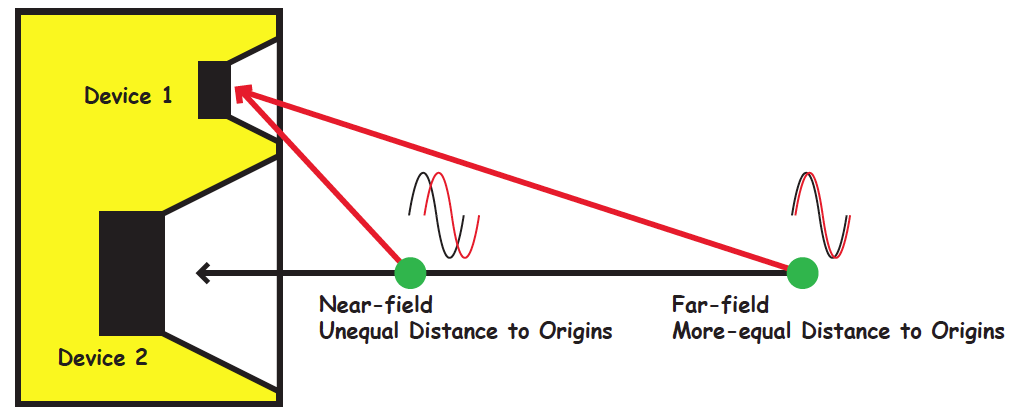
Imagine what happens when you have an array of multiple drivers of a panel that produces the same frequencies over the whole vertical length of the line.
The cancellation issues needn't be a problem if the loudspeaker is designed with the above taken into account. For example a simple way to compensate it, is to design the loudspeaker with a rising response towards higher frequencies. Measured at one point of the line the speaker would be too bright, but measured over the whole length, the cancellation would tame the top frequencies.
Some designers purposely curve their array backwards to do that: http://www.xlrtechs.com/dbkeele.com/ima ... ebsite.jpg
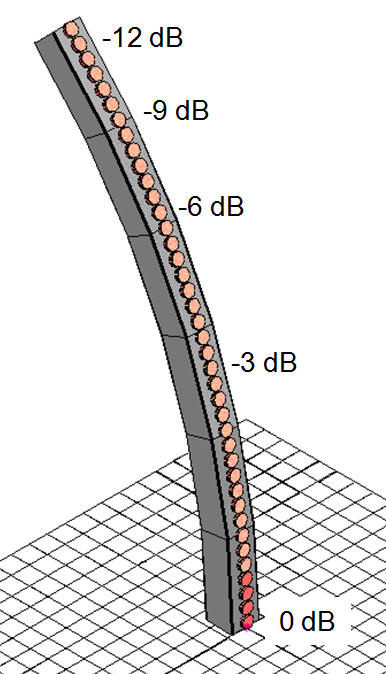
Kind regards,
Tony"
http://www.humblehomemadehifi.com/index.html
- Scinemaniac
- Posts: 69
- Joined: Tue Jul 06, 2010 1:22 pm
Re: Apogees rolled off or other speakers bright?
by User211 on Fri Mar 08, 2013 6:39 pm
"As anyone who's listened to the Vivids knows, they're simply incredible dynamic speakers, never sounding like cones and like all dynamics wickedly fast and able to generate bass Apogees can only dream of, shaking the room on the heartbeats at the start of "Dark Side of the Moon" where every Apogee..."
The first time I heard Vivids was at the Hong Kong Hi-Fi show in 2008. I've heard them a few times since.
I largely find them dull and really dislike the colouration that obviously stems from the cabinet material. I think a well tuned Duetta is leagues better.
With regards to Apogees sounding rolled off - something, sonewhere is wrong if you perceive that to be the case, IMHO. KLM5 running with a flat FR in a Duetta Sig is pretty damned flat when measured with test kit. I've done measurements myself. I actually run my Duettas with a mild HF roll-off to tame apparent brightness at high volumes. It works extremely well to my ears.
Just an opinion and please don't take offense because I do not like Vivid loudspeakers!!!
- User211
- Posts: 200
- Joined: Sat Jul 03, 2010 11:25 am
- Location: Bristol, England
Re: Apogees rolled off or other speakers bright?
by artm on Fri Mar 08, 2013 10:16 pm
"It works extremely well to my ears"
...and that's the secret ingredient. Go with whatever your ears like and TRY to ignore the opinions of those with better ears. I know it's difficult but in the end you'll be a happier listener.
I do not have audiophile eras by any means. I knew that decades ago when I became interested in this hobby. So, I relied on reviews of equipment by those with better ears and hoped that my purchases would be compatible with my ears as well as my wallet. It has worked well.
- artm
- Posts: 119
- Joined: Thu Jul 01, 2010 10:41 pm
- Location: Boston, MA USA
Re: Apogees rolled off or other speakers bright?
by kucharsk on Tue Apr 09, 2013 12:19 am
User211 wrote:I largely find them dull and really dislike the colouration that obviously stems from the cabinet material. I think a well tuned Duetta is leagues better.!!
I find that strange as I hear absolutely no cabinet coloration with Vivids - never have, which is what has made me take notice of them from the first time I heard them as I can hear coloration in just about any other loudspeaker made. Their cabinets are a carbon fiber composite that has no sound characteristic when "knocked," a lot like Wilson's "X" material (I can get a lot more resonance out of the frames of my Apogees.
)That having been said, the Calipers sit in a different room unsold right now as I'm not sure I can bear to part with them.
Definitely no offense taken, and I may still end up with a pair of Duetta Sigs someday, unless I move and have space for a pair of FRs!!
- kucharsk
- Posts: 38
- Joined: Mon Mar 07, 2011 7:54 pm
- Location: Colorado
Re: Apogees rolled off or other speakers bright?
by dimitri on Thu Apr 11, 2013 4:52 am
When I originally heard the Vivid B1s in 2007 at the Heathrow hifi show I was not impressed.
Susequent shows in Greece were better, but I also found them a bit dull (K1s as well).
I currently live in the country where they are being manufactured. I did listen a couple of
months ago to B1s and G1s here, and guess what; I liked them both. Considering the price
and looks, I probably like B1s better. Both speakers were driven by Devialet premier amplifier,
so this could be responsible for the change.
Dimitri
- dimitri
- Posts: 22
- Joined: Wed Aug 04, 2010 8:08 am
Re: Apogees rolled off or other speakers bright?
by wineslob on Fri May 17, 2013 7:45 pm
IMO all of the modern speakers I've listened to are too bright. I still use the M/RT's from my Duetta's and have found that they are so devoid of "artifacts" that they can sound dull., especially against dome tweeters. Horns are even worse, but I hear the artificiality of the aforementioned drivers. To my ears, the ribbon is just very neutral.
- wineslob
- Posts: 5
- Joined: Tue Jul 13, 2010 3:59 pm
21 posts
• Page 1 of 1
Who is online
Users browsing this forum: No registered users and 41 guests